Editorial take
Why it stands out
Agentuity should be evaluated as agent-native application infrastructure, not as just another SDK or prompt tool. The key comparison is against buying and integrating several separate infrastructure layers yourself.
Tool profile
Agent-native cloud platform for deploying, routing, and operating production AI agents with built-in storage, gateway, evals, and frontend primitives.
Deploying production AI agents
Agentuity belongs in the catalog because it is not trying to be another thin wrapper around model calls. The official positioning is much more ambitious: a full-stack platform for AI agents with deployment, intelligent routing, persistent state, APIs, storage, observability, AI gateway services, and React frontends in one operating surface. That matters for stack builders because the real friction in agent systems is rarely just prompt orchestration. It is everything around the agent once it has to run reliably, own state, expose endpoints, and move from laptop demos into production environments.
It also deserves inclusion because the pricing model is unusually explicit for an early agent-infrastructure platform. Agentuity starts users with $5 in free credits, then frames the rest of the product as usage-based infrastructure rather than a seat-heavy SaaS. The public pricing page exposes a live calculator, example per-session cost, storage pricing, and command, bandwidth, and storage rates. Editorially, that makes Agentuity a strong entry in the category of platforms that want to become the runtime layer for serious agent applications rather than just another orchestration toolkit.
Quick fit
Editorial take
Agentuity should be evaluated as agent-native application infrastructure, not as just another SDK or prompt tool. The key comparison is against buying and integrating several separate infrastructure layers yourself.
What it does well
Primary use cases
Fit notes
Compare with
Pressure-test this pick against nearby alternatives.
Pricing snapshot
Agentuity starts users with $5 in free credits and then charges usage-based infrastructure fees. The public pricing page shows a typical lightweight example at about $0.02 per month, and separately lists commands at $0.20 per 1,000, bandwidth at $0.03 per GB, and storage at $0.014 per GB.
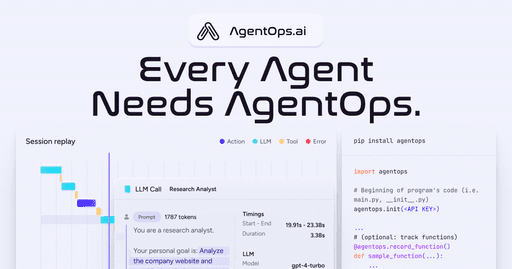
AgentOps
Free planAgent observability
Observability for AI agents with tracing, debugging, session visibility, and production monitoring.
Closer to agent observability than to model hosting or prompt tooling