Editorial take
Why it stands out
Amp should be described as a usage-priced coding agent product, not flattened into a generic AI IDE comparison.
Tool profile
Usage-based coding agent that focuses on raw model power, CLI workflows, and pass-through pricing instead of seat-based subscriptions.
Coding agents
Amp belongs in the catalog because it is one of the clearer attempts to center the coding product around model capability rather than around a conventional seat bundle. The official site positions Amp as a frontier coding agent with a CLI, subagents, and a philosophy of giving developers direct access to strong models without heavily constraining how they work. That makes it a relevant option for teams who care less about a traditional IDE wrapper and more about a flexible agent workflow that can evolve with model releases.
It also deserves inclusion because the pricing model is meaningfully different from most coding tools. The official manual says Amp charges based on actual LLM and certain tool usage, passes provider costs through at zero markup for individuals and non-enterprise workspaces, and does not require a subscription or commitment. That pricing posture should be preserved accurately, because it is central to how buyers will compare Amp with more familiar per-seat plans.
Quick fit
Editorial take
Amp should be described as a usage-priced coding agent product, not flattened into a generic AI IDE comparison.
What it does well
Primary use cases
Fit notes
Compare with
Pressure-test this pick against nearby alternatives.
Pricing snapshot
Amp does not require a subscription or commitment for standard usage. The official manual says non-enterprise usage is billed on actual LLM and tool usage with zero provider markup, the minimum credit purchase is $5, and enterprise usage is 50% more expensive with a special one-time $1,000 purchase to enable Enterprise.
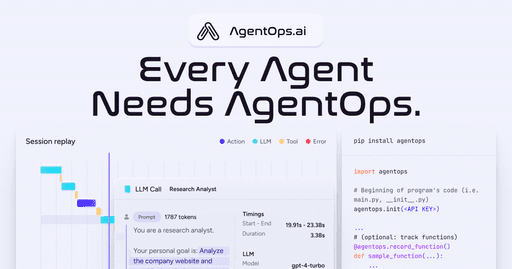
AgentOps
Free planAgent observability
Observability for AI agents with tracing, debugging, session visibility, and production monitoring.
Closer to agent observability than to model hosting or prompt tooling