Editorial take
Why it stands out
Galileo should be framed as an AI reliability platform, not merely an observability dashboard or prompt-testing utility.
Tool profile
AI reliability platform for evaluations, production observability, and guardrails that turn offline testing into live operational controls.
AI evaluations
Galileo belongs in the catalog because it represents a serious reliability layer for teams that have already moved beyond basic prompt experimentation. The official site now positions Galileo around evaluation engineering, production observability, and guardrails for agents and GenAI systems, with a specific emphasis on carrying offline eval work forward into production governance. That matters because many AI teams still stitch together separate tools for traces, quality checks, and policy controls. Galileo's product shape is stronger when the buyer wants those layers connected in one reliability workflow.
It also deserves inclusion because the public pricing posture is concrete enough to evaluate without pretending this is a lightweight hobby tool. The checked pricing page clearly exposes a free developer tier and a custom enterprise tier, and the structured pricing metadata is explicit about what the free plan includes. That gives buyers meaningful information even though the commercial step-up is sales-led rather than a long public self-serve ladder.
Quick fit
Editorial take
Galileo should be framed as an AI reliability platform, not merely an observability dashboard or prompt-testing utility.
What it does well
Primary use cases
Fit notes
Compare with
Pressure-test this pick against nearby alternatives.
Pricing snapshot
Galileo's public pricing currently exposes a free Developer plan with 5,000 traces per month, up to 3 users, and 1 organization, while the commercial path is a custom Enterprise tier with unlimited traces, users, and organizations plus enterprise deployment and support options.
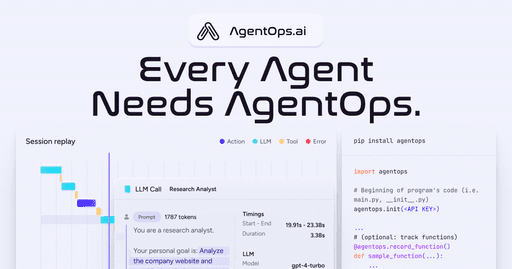
AgentOps
Free planAgent observability
Observability for AI agents with tracing, debugging, session visibility, and production monitoring.
Closer to agent observability than to model hosting or prompt tooling