Editorial take
Why it stands out
Graphlit should be framed as context infrastructure for AI agents, not as just another RAG layer.
Tool profile
Context layer platform for AI agents that handles ingestion, extraction, storage, retrieval, and knowledge graphs with public usage-based plans.
AI context infrastructure
Graphlit belongs in the database because it captures a category that is becoming increasingly important in agentic systems: context infrastructure. The official docs position Graphlit as the context layer for AI agents, offering ingestion from many sources, extraction pipelines, storage, semantic search, knowledge graphs, and temporal context through one API. That matters because Graphlit is not just another vector database wrapper or chat-with-your-docs tool. It is trying to be the infrastructure layer that gives agents operational memory and context across organizational systems.
It also deserves inclusion because the pricing is public and practical enough to compare. The official docs describe a free tier with 100 credits, then Hobby at $49/month plus usage, Starter at $199/month plus usage, Growth at $999/month plus usage, and Enterprise as custom pricing. That makes Graphlit a strong entry for teams deciding whether they want to assemble ingestion, extraction, graph, retrieval, and search systems by hand or buy the context layer as a platform.
Quick fit
Editorial take
Graphlit should be framed as context infrastructure for AI agents, not as just another RAG layer.
What it does well
Primary use cases
Fit notes
Compare with
Pressure-test this pick against nearby alternatives.
Pricing snapshot
Graphlit currently offers a free tier with 100 credits, Hobby at $49/month plus usage, Starter at $199/month plus usage, Growth at $999/month plus usage, and Enterprise as custom pricing.
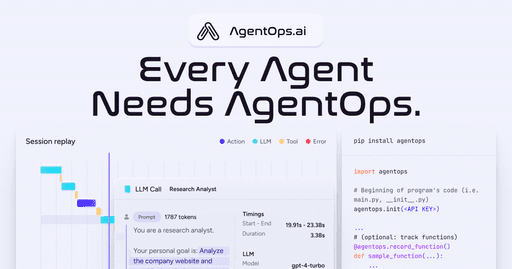
AgentOps
Free planAgent observability
Observability for AI agents with tracing, debugging, session visibility, and production monitoring.
Closer to agent observability than to model hosting or prompt tooling