Editorial take
Why it stands out
Guardrails AI should be positioned as a validation and enforcement layer for production AI systems, not as just another prompt helper.
Tool profile
Open-source framework for validating LLM inputs and outputs, enforcing policies, and generating structured data with reusable guards and validators.
LLM input and output validation
Guardrails AI is worth adding because it lives at a different layer than prompt frameworks or model gateways. Its real job is validation and policy enforcement around model I/O. The official docs describe two core functions clearly: running input and output guards to detect or mitigate risks, and helping generate structured data from LLMs. That makes Guardrails AI a strong fit for teams whose production concern is not just getting a response, but deciding whether a response should be accepted, corrected, blocked, or re-asked.
Its pricing story is partly open-source and partly commercial. The core framework is Apache-licensed and installable with `pip install guardrails-ai`, which makes entry free from a software-license standpoint. The quickstart also requires a free API key for Guardrails Hub, while the company site positions broader platform capabilities around reliability, evals, and production control. Importantly, there is no public self-serve pricing grid for the platform on the official site today. The honest editorial framing is that the OSS framework is free, while commercial pricing appears sales-led and should be verified directly with the company.
Quick fit
Editorial take
Guardrails AI should be positioned as a validation and enforcement layer for production AI systems, not as just another prompt helper.
What it does well
Primary use cases
Fit notes
Compare with
Pressure-test this pick against nearby alternatives.
Agenta
Free planLLMOps
Open-source LLMOps platform for prompt management, evaluation, observability, and collaborative AI application development with a clear hosted pricing ladder.
Choose Agenta when the team wants collaborative prompt management, evals, and observability in one hosted workflow.
Pricing snapshot
Guardrails AI's open-source framework is free to use and Apache-licensed. The official quickstart references a free API key for Guardrails Hub, while broader commercial platform pricing is not published in a public self-serve pricing grid and appears to be sales-led.
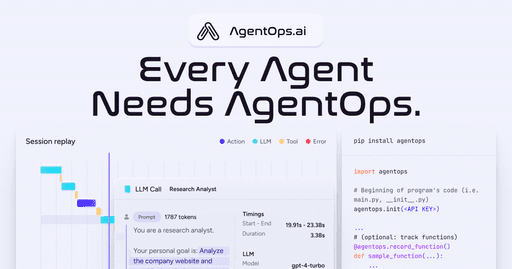
AgentOps
Free planAgent observability
Observability for AI agents with tracing, debugging, session visibility, and production monitoring.
Closer to agent observability than to model hosting or prompt tooling