Editorial take
Why it stands out
Guidance should be positioned as a control-oriented LLM framework, not as a generic agent platform or simple prompt library.
Tool profile
Open-source framework for controlling language-model generation with constrained decoding, structured output, and interleaved program logic.
Constrained generation and structured outputs
Guidance deserves a place in the database because it represents a very specific and still important design philosophy in LLM tooling: instead of treating prompts as plain text and post-processing the output later, it lets builders constrain generation while the model is producing tokens. The official docs emphasize constrained generation, regex and grammar control, token healing, and the ability to interleave generation with program logic. That gives Guidance a distinct place in the builder stack even as native structured-output APIs have improved.
The pricing story is open-source. Guidance is MIT-licensed and installable from PyPI, so the framework itself is free to use. The real economics come from the model backend you choose. If you run Guidance against OpenAI or another hosted provider, you still pay the provider. If you run it locally through llama.cpp or Transformers, your cost shifts toward infrastructure and hardware. That is the right editorial framing: Guidance is free software that can reduce waste and improve control, but it does not remove model-compute costs.
Quick fit
Editorial take
Guidance should be positioned as a control-oriented LLM framework, not as a generic agent platform or simple prompt library.
What it does well
Primary use cases
Fit notes
Compare with
Pressure-test this pick against nearby alternatives.
Pricing snapshot
Guidance is MIT-licensed open-source software with no public subscription price. The framework itself is free to use; practical cost depends on the underlying model backend and whether you run locally or through paid model APIs.
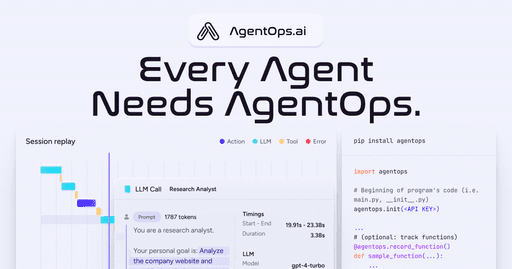
AgentOps
Free planAgent observability
Observability for AI agents with tracing, debugging, session visibility, and production monitoring.
Closer to agent observability than to model hosting or prompt tooling