
Editorial take
Why it stands out
Hyperbrowser should be evaluated as browser execution infrastructure. The core buying question is whether browser access is a mission-critical runtime dependency for the product.
Tool profile
Cloud browser and web-automation infrastructure built for AI agents, large-scale scraping, and session-managed browser execution.
Browser agents
Hyperbrowser belongs in the catalog because it addresses one of the hardest practical problems in AI automation: giving agents reliable access to real browsers at scale. The official positioning is fast cloud browsers for AI agents, automation, and large-scale scraping, and that framing matters. Hyperbrowser is not a no-code automation app or a generic SDK wrapper. It sits lower in the stack as execution infrastructure for teams that need browser sessions, stealth, session management, scraping, and AI-driven web tasks to work repeatedly in production.
Editorially, it also stands out because its public pricing is usage oriented instead of seat-centric marketing. Hyperbrowser exposes a free starting point, frames billing around prepaid credits and metered usage, and documents per-product costs for browser sessions and related APIs in its official reference material. That makes it a strong fit for stack builders evaluating browser-native agent systems, especially where real websites and session persistence are part of core product logic rather than an occasional add-on.
Quick fit
Editorial take
Hyperbrowser should be evaluated as browser execution infrastructure. The core buying question is whether browser access is a mission-critical runtime dependency for the product.
What it does well
Primary use cases
Fit notes
Compare with
Pressure-test this pick against nearby alternatives.
Agenta
Free planLLMOps
Open-source LLMOps platform for prompt management, evaluation, observability, and collaborative AI application development with a clear hosted pricing ladder.
Choose Agenta when the team wants collaborative prompt management, evals, and observability in one hosted workflow.
Pricing snapshot
Hyperbrowser is positioned as free to start with usage-based, credit-style billing for browser infrastructure rather than a simple seat plan. Its official documentation frames pricing around metered browser and web-automation usage rather than fixed workspace tiers.
AgentOps
Free planAgent observability
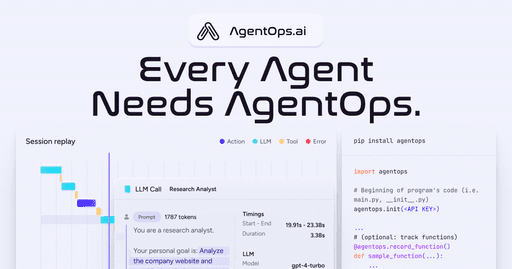
Observability for AI agents with tracing, debugging, session visibility, and production monitoring.
Closer to agent observability than to model hosting or prompt tooling