Editorial take
Why it stands out
LangChain is best treated as an integration and agent-development accelerator. The more critical the application becomes, the more deliberately teams should decide which parts of the framework stay in the core path.
Tool profile
Open-source framework for building model-connected applications and agents with reusable integrations.
Agent application development
LangChain is one of the default frameworks teams reach for when they need to connect models, tools, retrieval systems, memory, and agent control flow without starting from raw API calls. The current positioning is explicitly agent-oriented: LangChain provides prebuilt agent patterns, middleware, model and tool integrations, and a path into LangGraph's durable runtime for persistence, checkpointing, rewind, and human-in-the-loop workflows.
The strongest reason to add LangChain to a stack is ecosystem leverage. It has a large integration surface and a lot of community knowledge, which helps teams move quickly when model providers, vector stores, and application patterns keep changing. The tradeoff is abstraction discipline. LangChain is powerful, but production teams should keep a close eye on where framework convenience ends and explicit application architecture should begin.
Quick fit
Editorial take
LangChain is best treated as an integration and agent-development accelerator. The more critical the application becomes, the more deliberately teams should decide which parts of the framework stay in the core path.
What it does well
Primary use cases
Fit notes
Compare with
Pressure-test this pick against nearby alternatives.
Pricing snapshot
LangChain is an MIT-licensed open-source framework and is free to use. The adjacent LangSmith platform is priced separately, with Developer at $0 per seat/month plus usage, Plus at $39 per seat/month plus usage, and Enterprise custom pricing.
AgentOps
Free planAgent observability
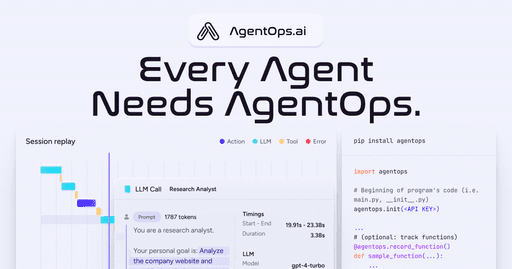
Observability for AI agents with tracing, debugging, session visibility, and production monitoring.
Closer to agent observability than to model hosting or prompt tooling