Editorial take
Why it stands out
Ragas should be framed as an OSS eval framework first, with any commercial layer treated as emerging rather than primary.
Tool profile
Open-source evaluation framework for LLM applications focused on experiments, metrics, synthetic test data, and production quality loops.
LLM evaluation
Ragas belongs in the database because it has become one of the most recognizable open-source names in LLM evaluation. The official site and docs position it as a library for moving from vibe checks to systematic evaluation loops, with support for experiments, metrics, synthetic data generation, online monitoring, and custom evaluation logic. That makes it a core builder tool rather than just a research toy. Teams use it to reason about RAG quality, agent behavior, prompt changes, and model regressions with more discipline than ad hoc spot checks.
It is also a strong entry because the commercial story is still light and the OSS story is real. The public project surfaces emphasize the open-source library and an early-stage hosted platform experience rather than a mature self-serve SaaS price card. For the directory, that means Ragas should be presented honestly as an OSS-first eval framework with optional enterprise and collaboration paths emerging around it, not as a polished fully-packaged platform yet.
Quick fit
Editorial take
Ragas should be framed as an OSS eval framework first, with any commercial layer treated as emerging rather than primary.
What it does well
Primary use cases
Fit notes
Compare with
Pressure-test this pick against nearby alternatives.
Pricing snapshot
Ragas is primarily presented on current official surfaces as an open-source evaluation framework. The checked public pages do not expose a mature standalone self-serve pricing table, so teams should treat it as OSS-first with enterprise or early-access platform conversations happening separately.
AgentOps
Free planAgent observability
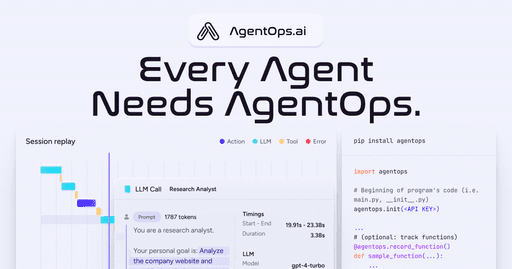
Observability for AI agents with tracing, debugging, session visibility, and production monitoring.
Closer to agent observability than to model hosting or prompt tooling