
Editorial take
Why it stands out
Semantic Kernel should be framed as an SDK and orchestration layer for AI applications, not as a hosted platform or a simple prompt helper.
Tool profile
Microsoft's open-source SDK for building AI applications and agents with plugin orchestration, memory, planning patterns, and model-provider integration.
AI application orchestration
Semantic Kernel is worth adding because it represents Microsoft's own answer to a core builder problem: integrating large language models into conventional application code in a way that stays structured, extensible, and future-proof. The official docs position it as a lightweight SDK for integrating LLMs with conventional programming languages, while the repository and documentation emphasize plugins, orchestration, memory, agents, and model-provider flexibility. That makes it highly relevant for teams who want an AI application framework with strong enterprise credibility but without immediately buying a whole managed platform.
Its pricing story is open-source at the framework layer. There is no public Semantic Kernel subscription plan on the official docs. The SDK is free to adopt, and real cost sits in whichever models, vector stores, and infrastructure services the team chooses beneath it. That is the right editorial framing: Semantic Kernel is free software, but it is an integration layer around services that often are not free.
Quick fit
Editorial take
Semantic Kernel should be framed as an SDK and orchestration layer for AI applications, not as a hosted platform or a simple prompt helper.
What it does well
Primary use cases
Fit notes
Compare with
Pressure-test this pick against nearby alternatives.
Agenta
Free planLLMOps
Open-source LLMOps platform for prompt management, evaluation, observability, and collaborative AI application development with a clear hosted pricing ladder.
Choose Agenta when the team wants collaborative prompt management, evals, and observability in one hosted workflow.
Pricing snapshot
Semantic Kernel is an open-source SDK with no public subscription price on the official docs. The SDK itself is free to use; practical cost depends on the model providers, memory stores, and infrastructure services used with it.
AgentOps
Free planAgent observability
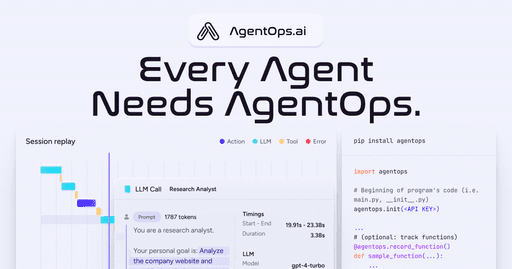
Observability for AI agents with tracing, debugging, session visibility, and production monitoring.
Closer to agent observability than to model hosting or prompt tooling