Editorial take
Why it stands out
VibeKit should be framed as a safety and execution layer for coding agents, not as a general AI IDE.
Tool profile
Open-source safety and execution layer for coding agents, adding sandboxing, redaction, and observability to Claude Code, Codex, Gemini, and related agent tools.
Coding agent sandboxing
VibeKit belongs in the database because safe execution is becoming a first-class concern as coding agents become more capable and autonomous. The official VibeKit pages position it as the safety layer for coding agents, with isolated execution, secret redaction, observability, and support for tools like Claude Code, Gemini, Codex, Cursor Agent, and OpenCode. That makes it an important infrastructure tool rather than just another AI coding assistant.
It also deserves inclusion because it solves a real operational problem in production and enterprise settings. Teams want the productivity gains of coding agents without letting arbitrary agent output run directly on local machines or exposed systems. VibeKit is one of the clearest tools focused on that boundary. Its economics are also easy to explain honestly: the core CLI and SDK are open source and free, while paid usage on official pricing surfaces is tied to Superagent model APIs such as Guard, Verify, and Redact rather than a generic seat plan for the open-source tooling itself.
Quick fit
Editorial take
VibeKit should be framed as a safety and execution layer for coding agents, not as a general AI IDE.
What it does well
Primary use cases
Fit notes
Compare with
Pressure-test this pick against nearby alternatives.
Pricing snapshot
VibeKit CLI and SDK are positioned on checked official surfaces as open source. Superagent's public pricing page currently lists token pricing for Guard, Verify, and Redact APIs at $0.9 per million input tokens and $1.9 per million output tokens.
AgentOps
Free planAgent observability
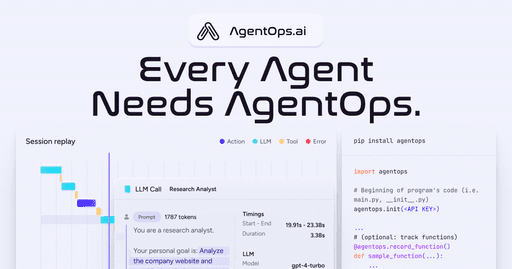
Observability for AI agents with tracing, debugging, session visibility, and production monitoring.
Closer to agent observability than to model hosting or prompt tooling