Editorial take
Why it stands out
vLLM should be framed as production inference infrastructure, not as a general AI framework.
Tool profile
High-throughput open-source inference and serving engine for LLMs with OpenAI-compatible APIs, efficient batching, and strong hardware flexibility.
LLM inference serving
vLLM belongs in the database because it has become one of the most important open-source inference engines for teams serving large language models in production. The official GitHub project describes it as a fast and easy-to-use library for LLM inference and serving, and the feature list is exactly what infrastructure buyers care about: high serving throughput, PagedAttention for memory efficiency, continuous batching, OpenAI-compatible APIs, quantization support, prefix caching, and broad hardware coverage. That makes vLLM a core builder tool rather than a wrapper library.
It also deserves inclusion because it fills a real stack-layer gap. A lot of AI-builder tooling focuses on orchestration, prompting, or evaluation, but production teams still need the model-serving layer underneath. vLLM is one of the clearest answers to that problem for open models. Its pricing is also easy to frame honestly: the upstream engine is open source and free, while the real cost comes from the compute environment and any commercial hosting or support chosen around it.
Quick fit
Editorial take
vLLM should be framed as production inference infrastructure, not as a general AI framework.
What it does well
Primary use cases
Fit notes
Compare with
Pressure-test this pick against nearby alternatives.
Pricing snapshot
vLLM is open source and free to use directly. The upstream project does not publish a standalone pricing page, so paid cost depends on the infrastructure, GPUs, hosting platform, and support model a team chooses around it.
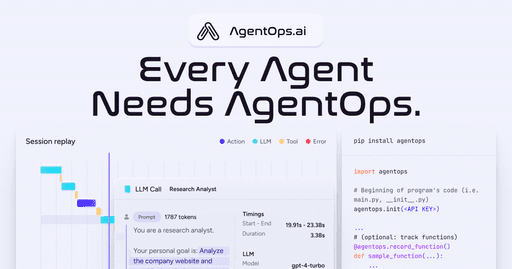
AgentOps
Free planAgent observability
Observability for AI agents with tracing, debugging, session visibility, and production monitoring.
Closer to agent observability than to model hosting or prompt tooling